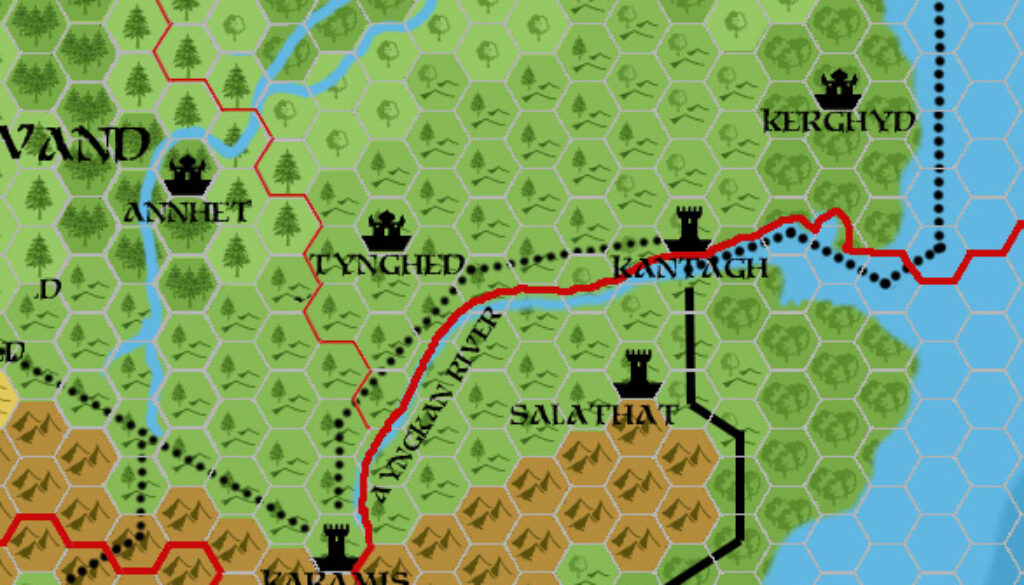
Chimpman’s Road to Isshum, 8 miles per hex
In April 2010, John posted about an adventure he was developing for his Mystara 2300 BC project. He included a map of the Shimmering Lands-Mogreth border, and explained the title in his post at The Piazza as follows:
The Road to Isshum is a reference to the commonly traveled path that slaves would take (presumably from The Shimmering Lands) to the slave markets of Isshum. I’ve cut a section of the BC 2300 map out below for reference
The map from which this was derived was most likely his Shimmering Lands v3 map — which is now lost to us, though we do of course have his latest v5 version of the map. Interestingly, the view shown here matches v5 very well, suggesting that the lost v3 map (dating to November 2009) was already largely complete.
Other than its relevance as a historical record, there’s nothing in this map that isn’t present in later versions.
Fan-made Map by John Calvin (April 2010)
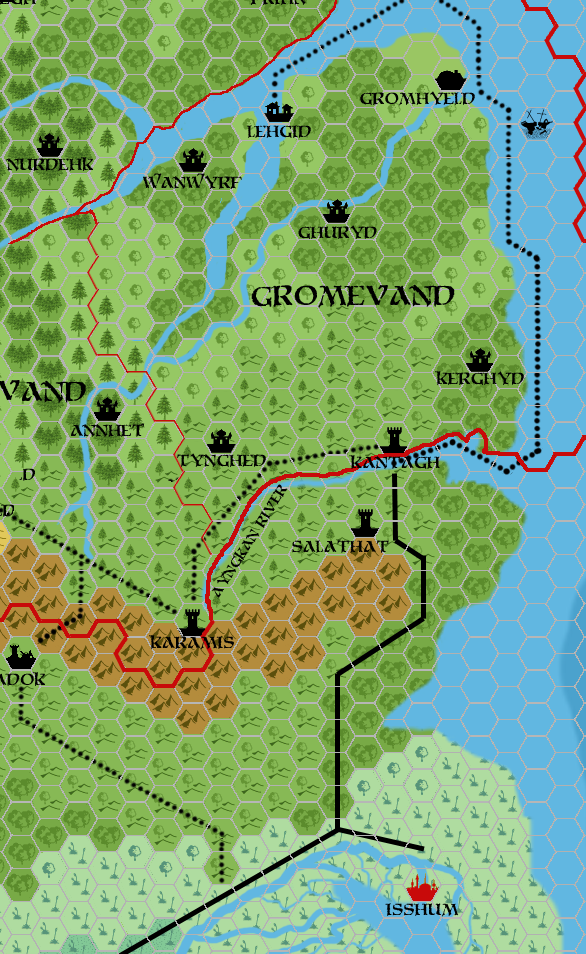
This is an original map created by one of Mystara’s excellent fan cartographers. For more information on the cartographer, including a gallery of all their maps, see also Appendix M: Mappers of Mystara.
Sources
Fan Sources
- Chimpman’s Shimmering Lands 2300 BC, 8 miles per hex v2 (May 2009)
- Chimpman’s Mogreth 2300 BC, 8 miles per hex v1 (August 2009)
- [Adventure] The Road to Isshum discussion thread at The Piazza (April-May 2010)
References
- All of John’s maps at the Atlas of Mystara
- John’s entry in Appendix M: Mappers of Mystara (upcoming)
- John’s author page at the Vaults of Pandius
Chronological Analysis
This is a fan-made map. It was published in April 2010. The updated Atlas version of this map is not yet available. See also Appendix C for annual chronological snapshots of the area. For the full context of this map in Mystara’s publication history, see the upcoming Let’s Map Mystara 2010.
The following lists are from the Let’s Map Mystara project. Additions are new features, introduced in this map. Revisions are changes to previously-introduced features. Hex Art & Fonts track design elements. Finally, Textual Additions are potential features found in the related text. In most cases, the Atlas adopts these textual additions into updated and chronological maps.
Under Construction! Please check back again soon for updates.