
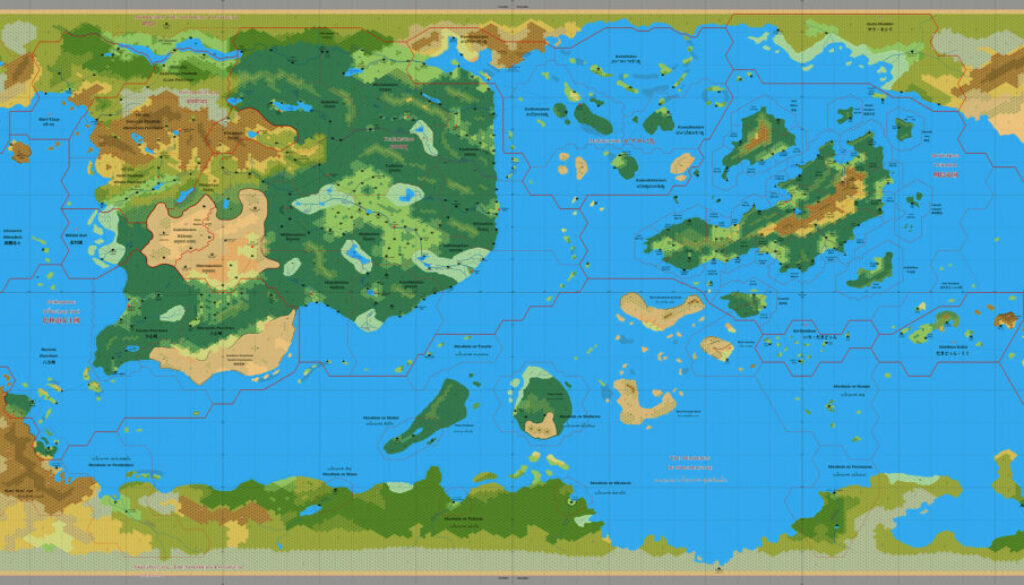
Ashtagon’s Patera, 8 miles per hex v1
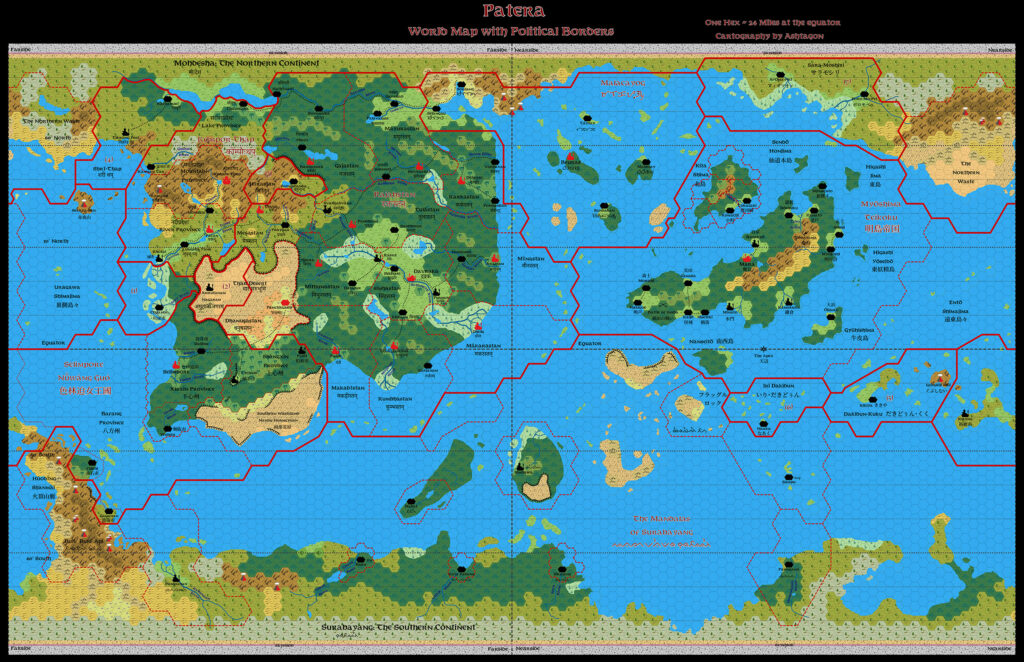
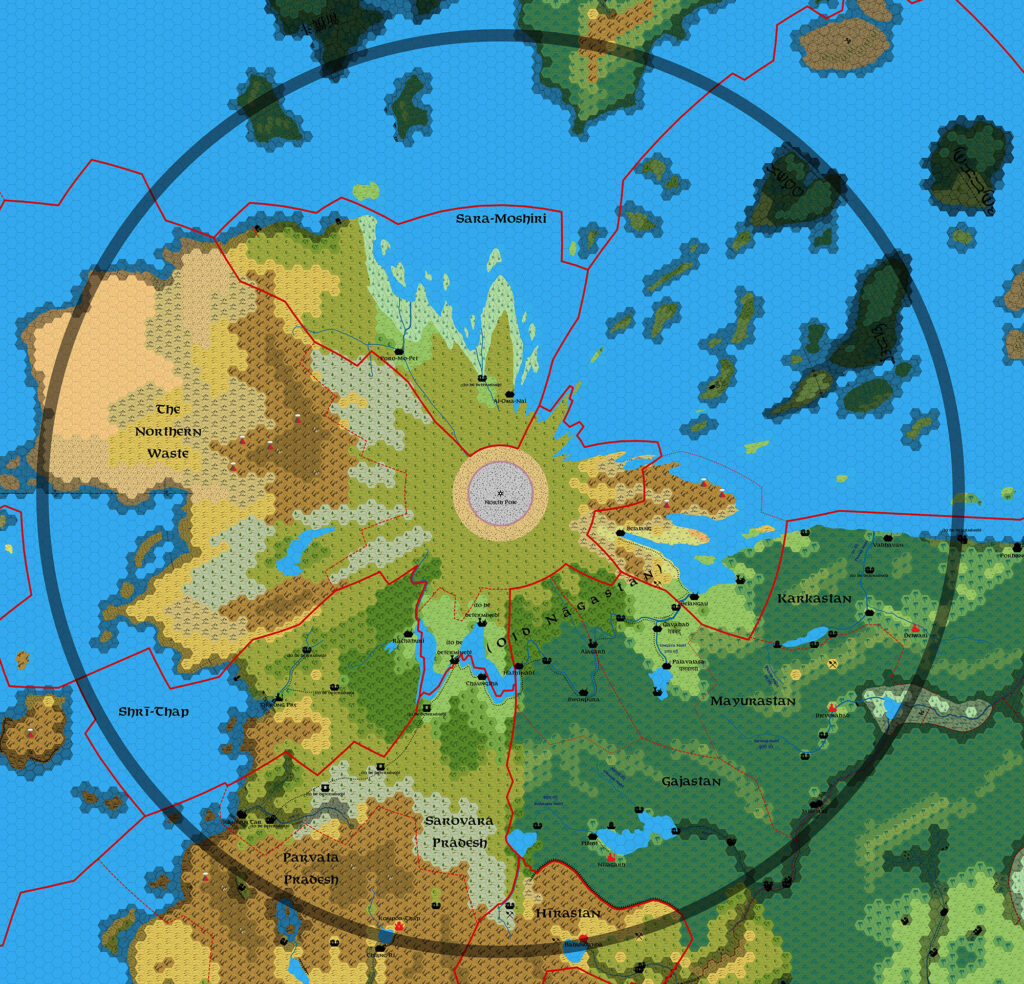
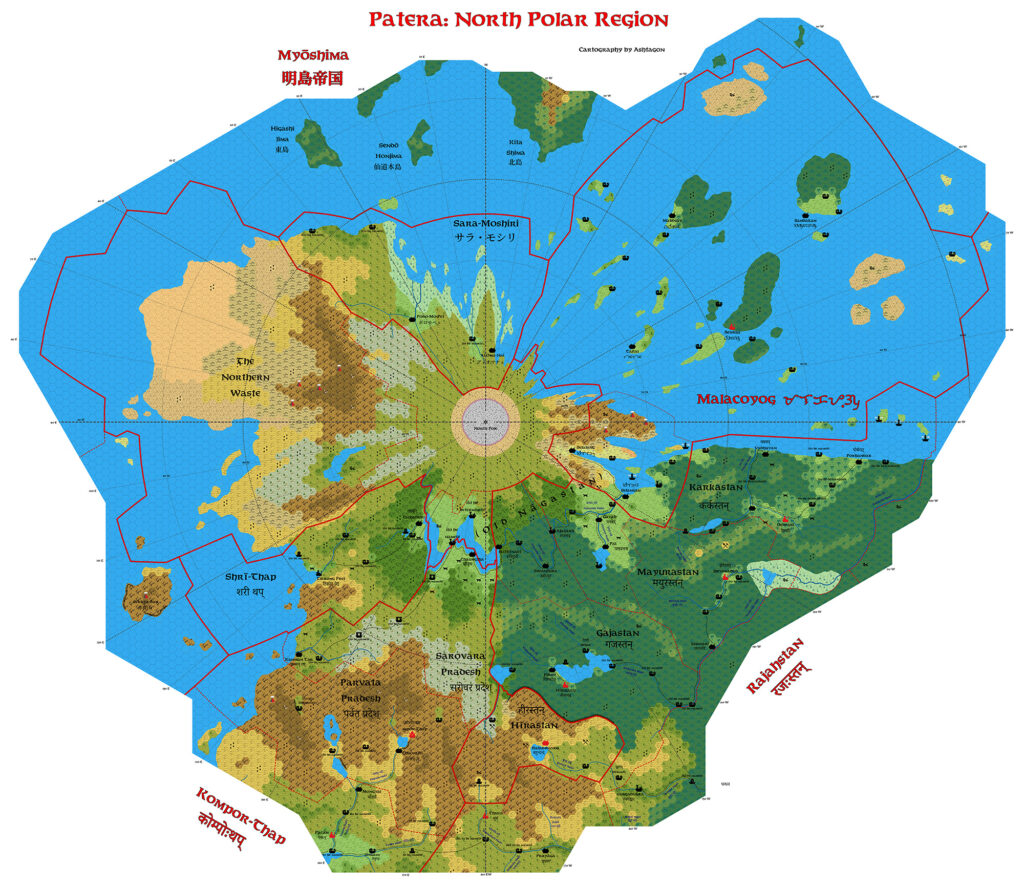
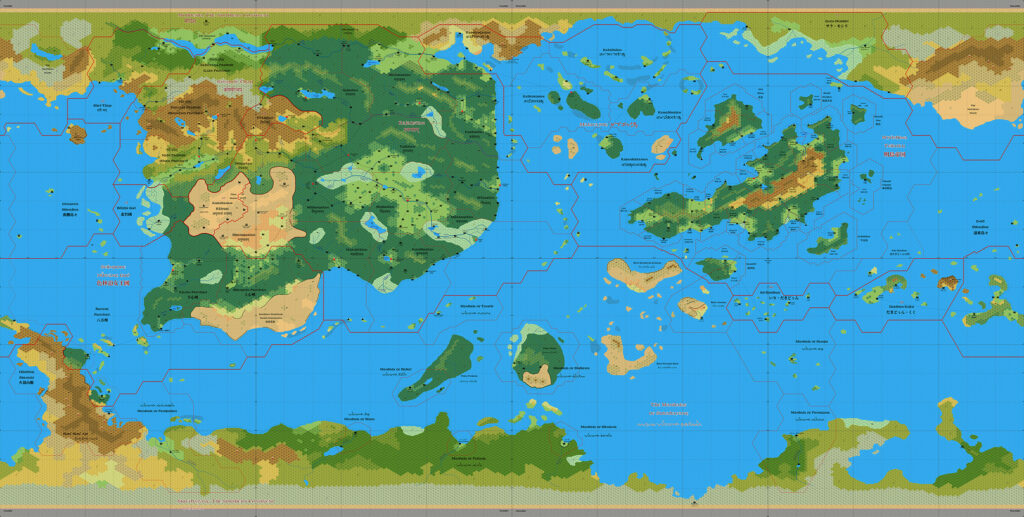
Presenting for the first time: Emma’s completed full map of Patera in Equirectangular projection, at 8 miles per hex. Thanks, Emma, for allowing me the honour of posting this for you. Even the lower resolution preview was too large for DeviantArt, so here it is. Note that the version below is a 100 DPI preview of the full map. It’s still rather huge even at that resolution, but the full, 300 DPI version linked to below is even larger.
This has been a labour of love for Emma, and her finished map is so rich in detail that it may leave you wondering if there isn’t something else up her sleeve — another secret project, perhaps. Who knows? We’ll have to wait and see.
As I remarked on her other Patera maps and previews, she made each nation feel unique through a combination of names appropriate for the real world culture that inspired the Mystaran nations, and scripts that render those names in an approximation of their local styles.
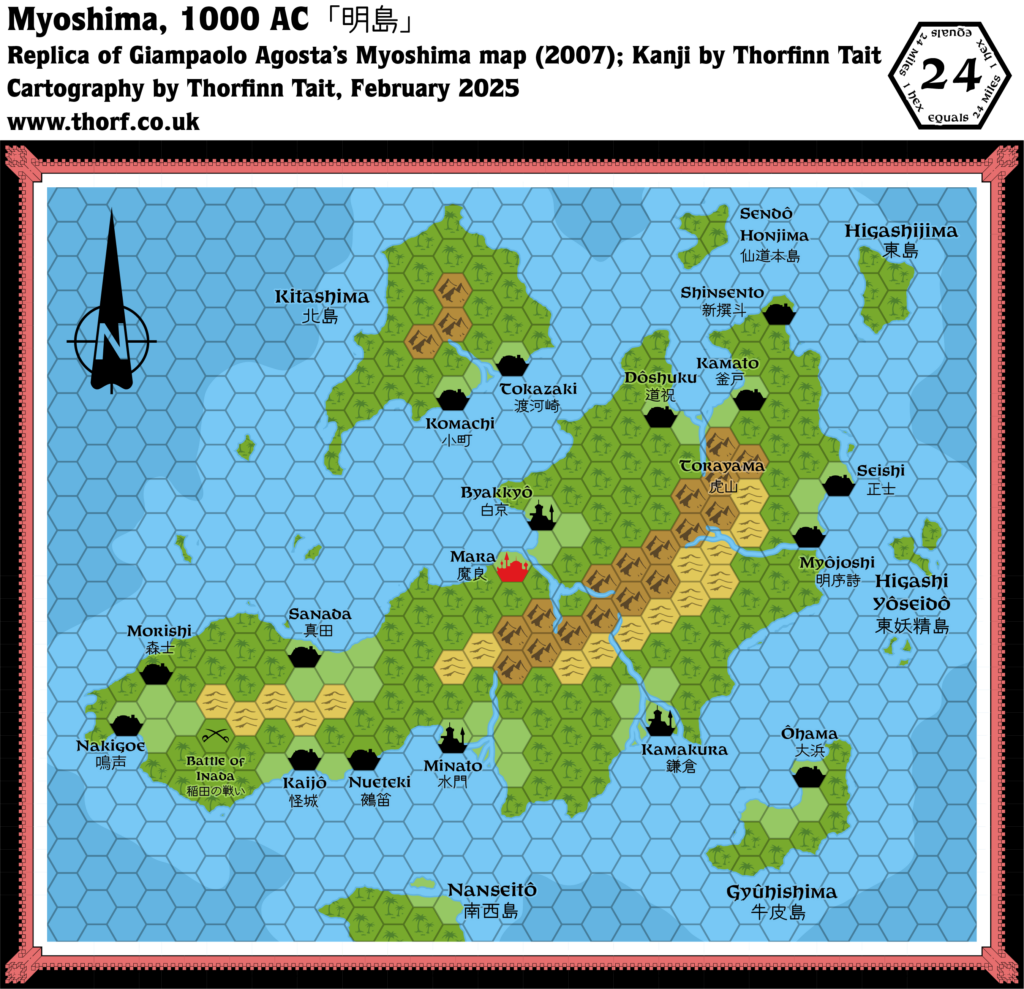
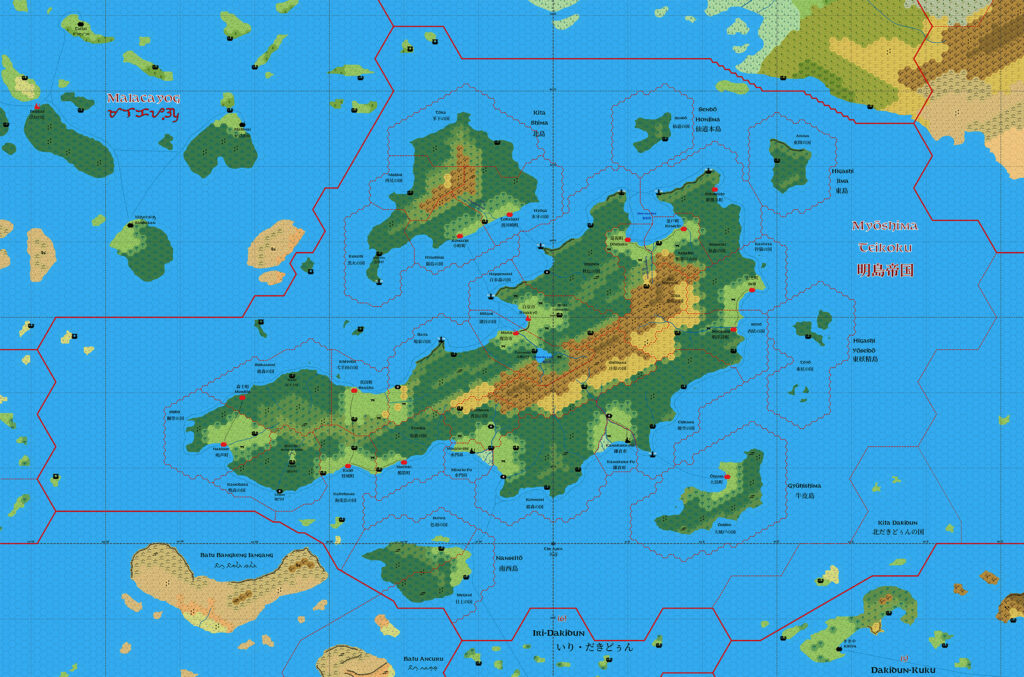
Emma explained some of her choices in a post at The Piazza detailing her preview of Myoshima from this map:
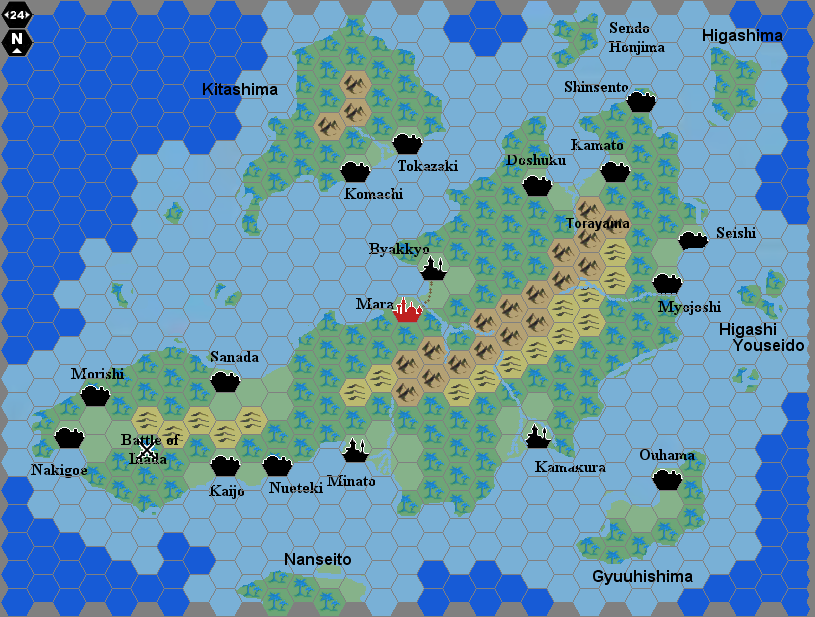
Myoshima itself uses mainly Japanese kanji (with occasional hiragana for “loan words” and grammatical particles).
The free (and “free”) nations of Dakidun (in the south east) use hiragana. They are modelled off Okinawa and the Ryukyu kingdom.
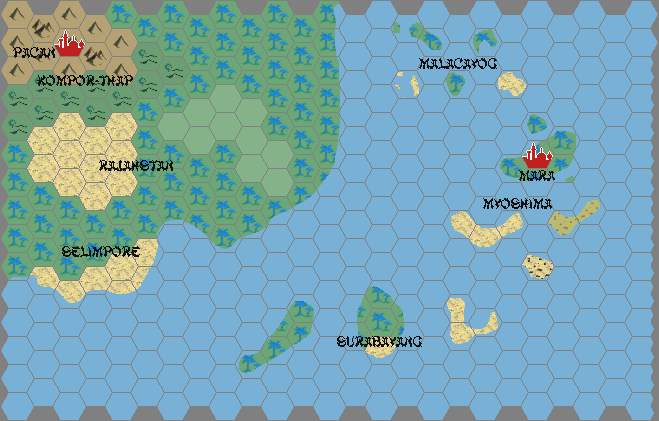
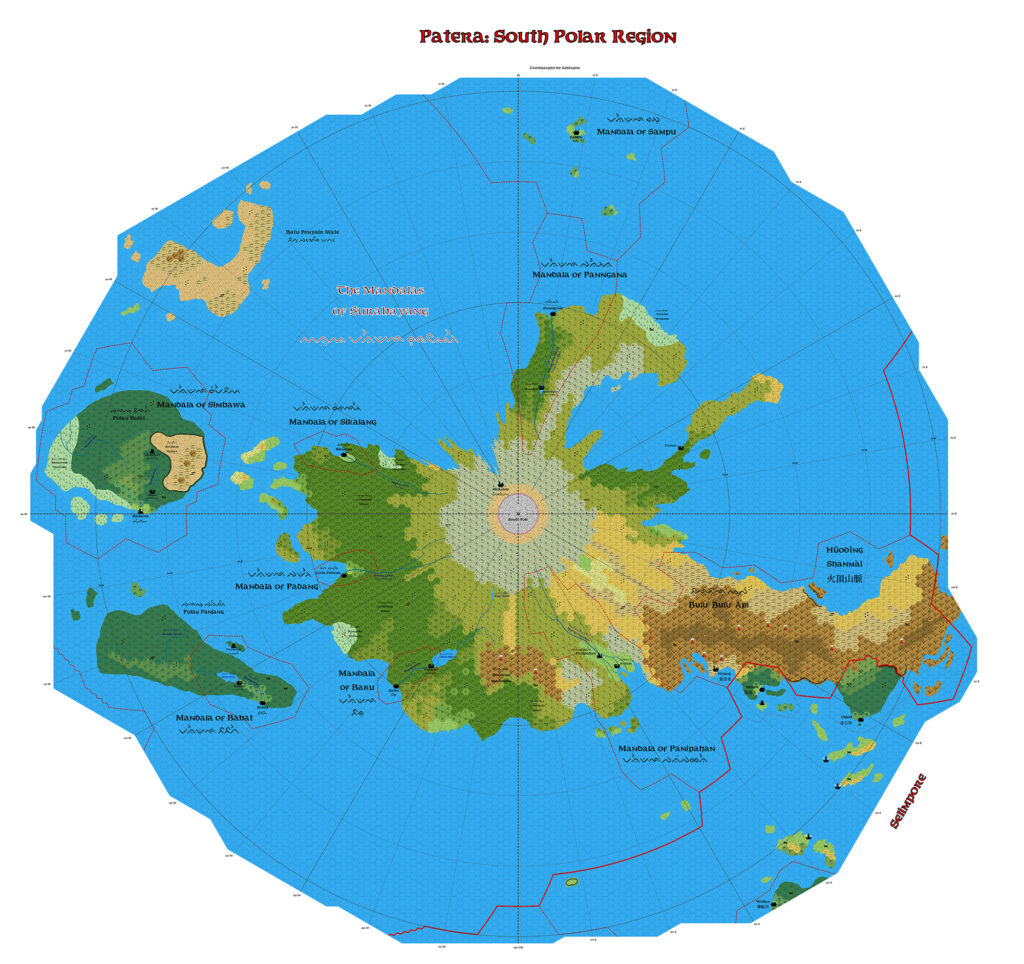
In the south … we can see parts of the Surabayang cultural region. They use the Lontara script, which IRL sees some use on Sulawesi in Indonesia.
And in the north … Malacayog uses the Baybayin script, which IRL is used in the Philippines to write Tagalog.
Note that I left out some of her original text, since the description applied to the cropped Myoshima map; this edit should make it readable for this map, too.
In addition to these, there’s also Chinese script in Selimpore, as well as Devanagari in Rajahstan.
Edit: Emma posted an extended explanation on Facebook:
Some additional notes on the scripts used (because the earlier comment only covers those that were visible on the Myoshima map):
Sara-Moshiri (the Ainu analogue) uses Japanese katakana. This writing system isn’t especially well-suited to the language, but it’s the only real option that respects the indigenous culture.
As Thorf noted, Selimpore uses traditional Chinese hanzi.
Rajahstan uses the Devanagari script, as befitting a culture inspired by India.
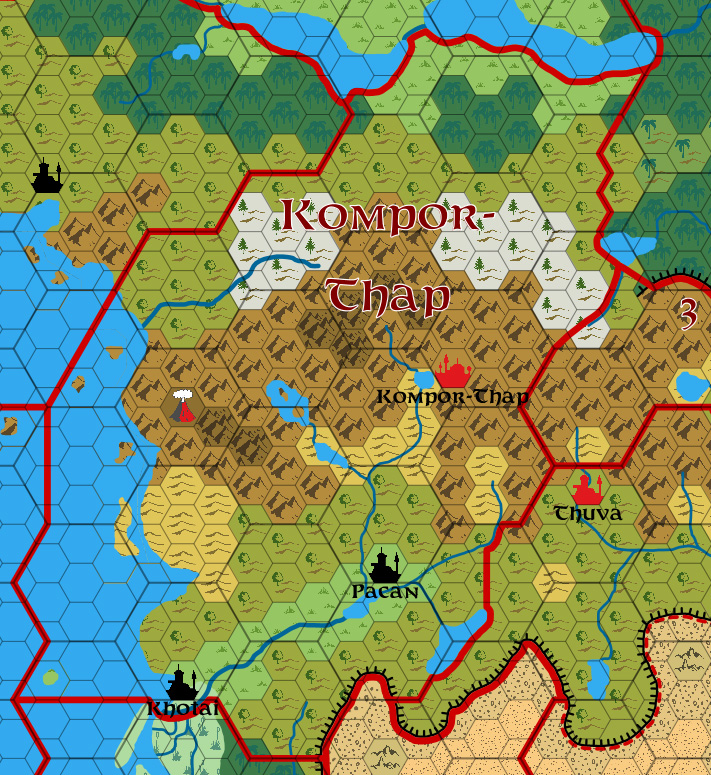
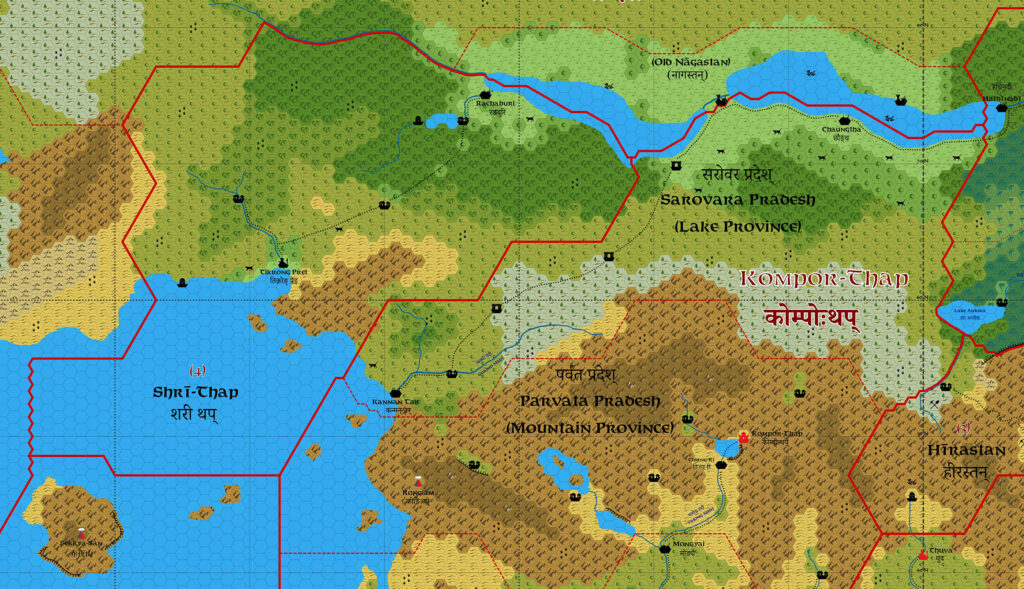
For Kompor-Thap, I bounced between Tibetan, Thai, and Burmese scripts, as well as others from the region, as my vision of the culture is a mix of these. I finally settled on using Devanagari, because the history says they were essentially the cultural teachers of the Rajahstani, so it would make sense for them to have the same writing system.
The city of Pahit in Selimpore is an exception to everything. They use the Yi script, which in the real world is native to southwest China.
Finally, I have marked this as version 1, though at the time of publication it’s the only version. I did this simply because a map of this size and scope seems almost guaranteed to see further tweaks and development.
What a masterpiece! Thank you, Emma, for an amazing work. The Atlas of Mystara salutes you!
Fan-made Map by Emma Rome (August 2026)
Full Resolution >>>>> Patera, 8 miles per hex (300 DPI) <<<<< Right Click, Save
This is an original map created by one of Mystara’s excellent fan cartographers. For more information on the cartographer, including a gallery of all their maps, see also Appendix M: Mappers of Mystara.
The map above is a lower resolution preview. To download the full size version, please follow the link (right click and choose “Save Link As…” or equivalent). Mobile Users, please note that it may not be possible to view the full resolution image on your device due to its large size.
Full Resolution >>>>> Patera, 8 miles per hex (300 DPI) <<<<< Right Click, Save
Sources
Fan Sources
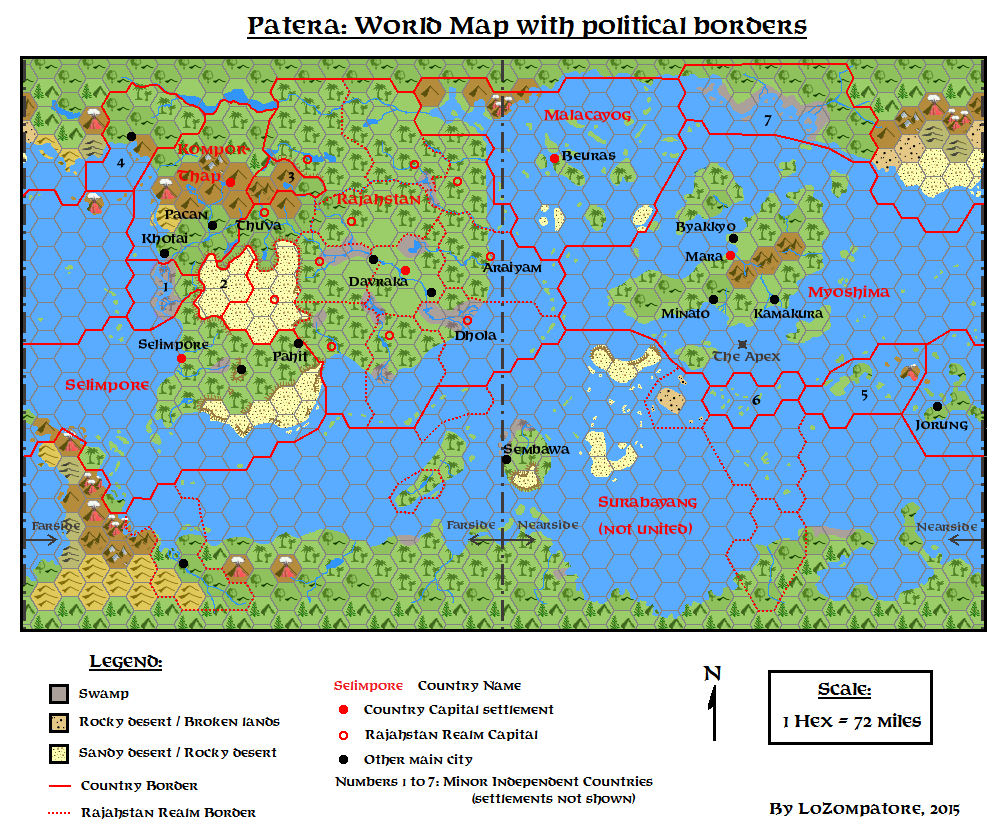
- Ashtagon’s Patera, 24 miles per hex v2 (September 2025)
References
- All of Emma’s maps at the Atlas of Mystara
- Emma’s entry in Appendix M: Mappers of Mystara (upcoming)
- Emma’s author page at the Vaults of Pandius
Chronological Analysis
This is a fan-made map. It was published in August 2026. The updated Atlas version of this map is not yet available. See also Appendix C for annual chronological snapshots of the area. For the full context of this map in Mystara’s publication history, see the upcoming Let’s Map Mystara 2025.
The following lists are from the Let’s Map Mystara project. Additions are new features, introduced in this map. Revisions are changes to previously-introduced features. Hex Art & Fonts track design elements. Finally, Textual Additions are potential features found in the related text. In most cases, the Atlas adopts these textual additions into updated and chronological maps.
Under Construction! Please check back again soon for updates.

2 September 2026 @ 12:30 am
Great map!
—Is “Pahit” in Yi script?
—I think Kompor-Thap would be in Khmer script.
—And that Surabayang would use Java script.
—Nice Baybayin for Malacayog.
—Nice Chinese for Selimpore, though Singapore uses Simplified Characters, not Traditional.
—All cartographers have missed the port of “Nakamura” mentioned by Roger Moore in Polyhedron 120.
2 September 2026 @ 4:00 pm
Hi Sionnainn. Well spotted on the Yi script. That one is really rare, and I wasn’t expecting anyone to identify it easily.
For Kompor-Thap, Khmer was one of the scripts I considered, among several others. The key deciding factor was a world-building one though. Given Kompor-Thap’s role as the historical ‘first’ culture on Patera, their direct role in teaching the rakasta, and ongoing trade ties, it wouldn’t make much sense for them to have anything other than the same writing system as Rajahstan. Using Khmer script would also tie Kompor-Thap to RW Cambodia, forcing me to develop it as an expy of that country, rather than the cultural blend I want to make it.
Regarding Surabayang. There’s about half a dozen writing systems native to Indonesia. Javanese is perhaps the most commonly used non-Latin script. With the M-Simbawa/RW-Sumbawa connection in the pre-existing names, it made more sense to pick Lontara script over the others.
That Nakamura from Polyhedron… it’s actually a place from OA4 Blood of the Yakuza. Roger Moore had the in-article GM rename it from Nakamura for the purpose of his Myoshima campaign, but didn’t write what it would be renamed to. So even in the context of that article, there isn’t a town called Nakamura on Myoshima. If you want, you can rename the town of Ketto to Nakamura (and even use the OA4 background for the town) for your campaign.